.avif)
A companion to “More Than ‘The Nanny’: How Pop Culture Shapes (and Sometimes Misshapes) Our View of Nannies”
We’ve spent a lot of years thinking about who gets to be a nanny — not just in real life, but in the stories we tell. In a recent blog, we walked through the characters who shaped how most people picture this profession: Mary Poppins drifting in on a spoonful of sugar, Fran Fine commanding every room she walked into, Chessy making the Porters feel whole. We love those characters, and we meant it when we said they’ve done real good for how caregivers are perceived.
That post, and those characters, don’t come close to telling the whole story. We mentioned in passing that the history of domestic caregiving in this country is rooted in the labor of Black women, Indigenous women, and women of color. Since that blog, we’ve heard from a lot of readers and friends on social media about how this lack of representation has impacted their careers, their mindsets about nannying, and the misperceptions that families often bring into their journey with nannies as a direct result of these characters setting the tone in mainstream media about what a fantastic nanny looks and sounds like.
The representation gap in pop culture is worth naming plainly. Go ahead and Google “movies about nannies.” What comes back is a short, familiar list — the ones that rise to the top without any effort, the ones that get made into GIFs and Halloween costumes and think pieces. Almost all white and almost all centered on a caregiver who arrives as a charming outsider rather than a person with their own full, complicated life.
Now try “movies about Black nannies.” Or “films about Latina caregivers.” Or “Southeast Asian domestic worker films.” Suddenly an entirely different world opens up — extraordinary, award-winning films, many of them in the Criterion Collection, many of them Sundance and Cannes winners. They’ve been here the whole time -they just require more specific searches to surface.
There’s something worth sitting with in that. The idea that the default, unqualified version of this profession — the one that needs no adjective — is white. Everything else requires a qualifier. That’s not a reflection of who has actually done this work. It’s a reflection of whose stories get indexed and handed to you without effort.
This list was built from that second search — and the third, and the fourth. These aren’t films we’re recommending as a corrective exercise; they’re genuinely extraordinary on their own terms. Watch them because they’re good. Watch them because they tell caregiving from the inside.
The History That Doesn’t Make It Into the Highlight Reel
In our last post, we wrote that nannies have “long served as symbols of warmth, wisdom, and a little bit of magic” in pop culture. That’s true for the characters most people know. But before those characters existed, before the archetypes got codified into British governesses and sitcom au pairs, there were millions of real people doing this work under conditions that had nothing to do with magic.
Domestic childcare in the United States has always been shaped by race, labor laws, gender dynamics, and power. During and after slavery, Black women were compelled to care for white children — nursing, raising, and loving children who were not their own while being separated from their own families. It was not employment. It was extraction.
After emancipation, domestic work became one of the only paid labor options available to Black women for decades. It remained poorly paid by design. The Fair Labor Standards Act of 1938 — which established minimum wage and overtime protections for most American workers — explicitly excluded domestic workers. That exclusion was not an oversight. It was a political compromise engineered to protect the labor practices of Southern states. Domestic workers weren’t included in federal overtime protections until 2015. Today the National Domestic Workers Alliance estimates there are 2.5 million domestic workers in the United States. The majority are women of color. Many are immigrants. Most still work without full labor protections.
Indigenous women have their own parallel and distinct history here — one tied to colonization, the forced disruption of families, and coerced labor that has never been fully reckoned with. Latina women, particularly from Mexico, Central America, and the Caribbean, have made up a significant and largely invisible portion of the paid childcare workforce throughout the 20th and 21st centuries: underpaid, without benefits, excluded from the legal protections most other workers take for granted.
This isn’t only an American story. An estimated 67 million people worldwide work as domestic workers, and only 10% of them have labor protections equivalent to those extended to other workers. In Southeast Asia, the Middle East, South America, and across Africa, domestic work has long been organized along lines of race, national origin, and class — with workers from poorer countries traveling to wealthier ones to care for other people’s children while leaving their own behind.
The numbers on representation make the gap plain. A 2022 joint study by the NDWA and the USC Annenberg Norman Lear Center — analyzing 47,000 keyword mentions across more than 100 film and TV titles from 1910 to 2020 — found that while roughly 42% of domestic workers in the United States are white, 69% of domestic worker characters on screen are white. White characters in those roles got more complex storylines, more dialogue, more interiority. One in three references to domestic workers across the sample was pejorative.
“The archetype of the nanny as a young white woman from a good family is not the history. It is an exception that got promoted to the main story.”
We believe that changing who we see in these stories is part of changing who gets seen, considered, and valued in this profession. That’s not a small thing. It’s the whole thing. Here’s a place to start.
UNITED STATES
Nanny (2022)
Directed by Nikyatu Jusu — Prime Video and Criterion Channel — Sundance Grand Jury Prize, US Dramatic Competition
Aisha (Anna Diop) is a Senegalese immigrant working as a nanny for a wealthy Upper East Side family, sending money home so she can eventually bring her son to the US. Director Nikyatu Jusu — a Sierra Leonean American filmmaker — weaves West African folklore through the film: Mami Wata, Anansi, figures of resistance and spiritual reckoning who begin to inhabit Aisha’s waking life as her employers underpay her overtime, move her boundaries, and treat her as simultaneously indispensable and invisible.
The thing that makes this film essential is that it doesn’t observe Aisha’s experience from the outside. It lives inside it completely — the specific grief of caring for someone else’s child while your own is an ocean away. At Sundance, Jusu dedicated the film to “immigrant mothers who support their children, even when they must leave them behind.” Now in the Criterion Collection.
Losing Isaiah (1995)
Directed by Stephen Gyllenhaal — Halle Berry, Jessica Lange
Khaila (Halle Berry) is a Black woman in recovery who, in a moment of crisis, left her infant son — and must now fight to reclaim him after he’s been adopted by a white family. The film takes seriously the full tangle: race, love, legal systems, and what “best interest of the child” actually means when those systems were not built with all families equally in mind. It doesn’t offer easy resolution. It holds the tension. Berry’s performance is among her finest, and the questions the film raises about race, kinship, and the child welfare system are still unresolved.
Maid (2021)
Created by Molly Smith Metzler — Based on Stephanie Land’s memoir — Netflix
A ten-episode limited series following Alex (Margaret Qualley), a young mother who escapes an abusive relationship and takes domestic work to survive. Most caregiving narratives focus on the care given to other people’s children. Maid centers what happens when the caregiver is simultaneously fighting to keep her own. The show is unflinching about the economics: low wages, no benefits, no safety net, and a social services system that is both lifeline and trap. The most honest mainstream American portrait of domestic work we’ve seen.
Real Women Have Curves (2002)
Directed by Patricia Cardoso — America Ferrera — Sundance Audience Award and Special Jury Prize
One of the most honest portraits of Latina domestic labor and intergenerational caregiving in American film. The love between Ana and her mother carries every tension that kind of love contains: sacrifice, resentment, pride, and the complicated work of caring for people who are also asking too much of you. The film understands that care work doesn’t only exist in formal employment — it lives inside families, passed down and extracted and occasionally, fiercely, reclaimed. Frequently cited by Latina domestic workers as the film that most accurately reflects their family dynamics.
Lucy by Jamaica Kincaid (1990)
Novel — Farrar, Straus and Giroux
Lucy arrives in New York from Antigua to work as an au pair for a white American family. Kincaid’s prose is spare and devastating. Lucy is not grateful, not accommodating, not there to warm anyone’s heart. She is figuring out who she is outside the role she’s been assigned, and the novel refuses to soften or reward that process. One of the most clear-eyed pieces of writing about caregiving, immigration, power, and selfhood in any genre.
Toni Morrison — Beloved (1987), The Bluest Eye (1970), and her critical essays

Poet, Author, 1993 Nobel Prize for Literature
Morrison’s fiction and critical writing provide the deepest literary excavation available of what was asked of Black women as caregivers in America, the costs of that asking, and the ways that history has been sentimentalized beyond recognition in popular culture. The “mammy” archetype — the devoted, selfless Black caregiver who exists entirely in service to a white family — is one of pop culture’s most persistent and most damaging representations. We mentioned it in our last post. Morrison spent her career examining what that archetype erased and who it required Black women to disappear into. Her work is the essential companion to everything else on this list.
Imitation of Life (1959)
Directed by Douglas Sirk — Juanita Moore, Lana Turner — Academy Award nominee: Best Supporting Actress (Juanita Moore) — National Film Registry, Library of Congress — Available on TCM and streaming platforms
Annie Johnson (Juanita Moore) shows up in this film the way caregivers so often show up in real life — precisely when she’s needed, taking on more than was asked, and making herself indispensable before anyone has agreed to the terms. This 1959 melodrama is the one most people think of when they think about Hollywood and the “mammy” archetype we mentioned in our last post — the devoted Black woman whose world revolves entirely around a white household. And it’s true that the script is built on that architecture. But Juanita Moore does something in this performance that the script doesn’t fully account for. She plays Annie not as an ideal type but as a complete person: warm, funny, quietly strategic, and quietly devastated by the one thing she cannot fix, which is her light-skinned daughter Sarah Jane’s refusal to be Black. Annie understands exactly why her daughter runs. She doesn’t stop loving her for it.
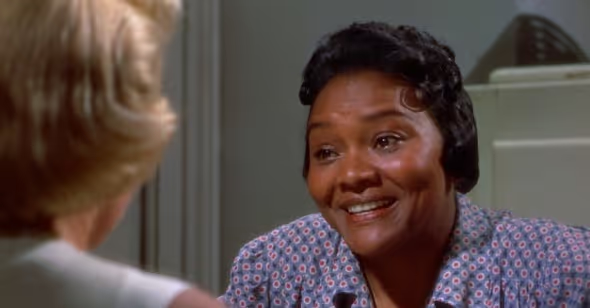
What makes this film essential is how clearly it shows the bargain that domestic work has always required: total availability in exchange for shelter and survival. Annie’s labor funds a life she cannot fully participate in. The film was selected for preservation in the National Film Registry as culturally and historically significant. Watch it as a document of what Hollywood was and wasn’t able to say about race and caregiving in 1959. Watch Moore’s performance for what it says regardless.
Black Girl / La Noire de… (1966)
Written and directed by Ousmane Sembène — Senegal/France — Criterion Channel — Prix Jean Vigo; first sub-Saharan African film to receive international recognition
Diouana (Mbissine Thérèse Diop) is a young woman in Dakar who has been working as a nanny for a French family — playing with their children in the sun and the open air of Senegal. When the family invites her to follow them to their apartment in Antibes, she accepts. She has heard that France is beautiful. She imagines something like freedom.
She arrives, and the children are not there. There is an apartment. There is a kitchen. There is Madame. The film is 59 minutes long. It contains almost no dialogue. The work is relentless, and the work is not what she came for, and the work does not stop. The film’s original French title, La Noire de…, was a common shorthand of the era for domestic servant. The title cuts off mid-sentence. Of whom. Of where. Of what. The blank is the point.
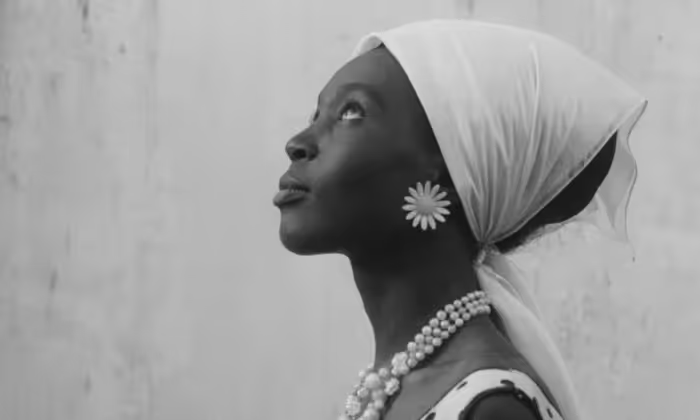
If you’ve seen Nanny (2022) — Nikyatu Jusu’s film about a Senegalese immigrant nanny in New York — watch Black Girl alongside it. They are in direct conversation across six decades: the same geography of origin, the same promise of a different life in a wealthier country, the same architecture of confinement on arrival.
The Long Walk Home (1990)
Directed by Richard Pearce — Whoopi Goldberg, Sissy Spacek — Prime Video, Tubi (free) — Cinematography by Roger Deakins
It’s December 1955 in Montgomery, Alabama. Odessa Cotter (Whoopi Goldberg) is a maid and caregiver for the Thompson family — a white, middle-class household where she is essential and, in the way these arrangements usually worked, invisible. Then Rosa Parks refuses to give up her seat on a city bus, and 50,000 Black residents of Montgomery begin boycotting the system that has required them to sit in the back. Odessa joins them. She walks nine miles each way to the Thompson house. She walks in the dark in the morning and in the dark at night, and she does not say a word about it at work.
The film follows both Odessa and her employer Miriam (Sissy Spacek) — two women in the same household navigating the same historical moment from completely different vantage points. What it gets right, and what distinguishes it from other films about this period, is that it doesn’t reduce Odessa to her role in Miriam’s awakening. The film goes home with Odessa. We see her family, her church community, her daughter’s fear, her husband’s calculations about risk, the specific weight of being a person whose livelihood depends on not alarming the people you work for. Her dignity is not something the film grants her. She arrives with it. Goldberg’s Odessa is one of the finest portrayals of a domestic worker in American cinema, and one of the least discussed.
LATIN AMERICA
Roma (2018)
Directed by Alfonso Cuarón — Netflix — Academy Awards: Best Director, Best Cinematography, Best Foreign Language Film
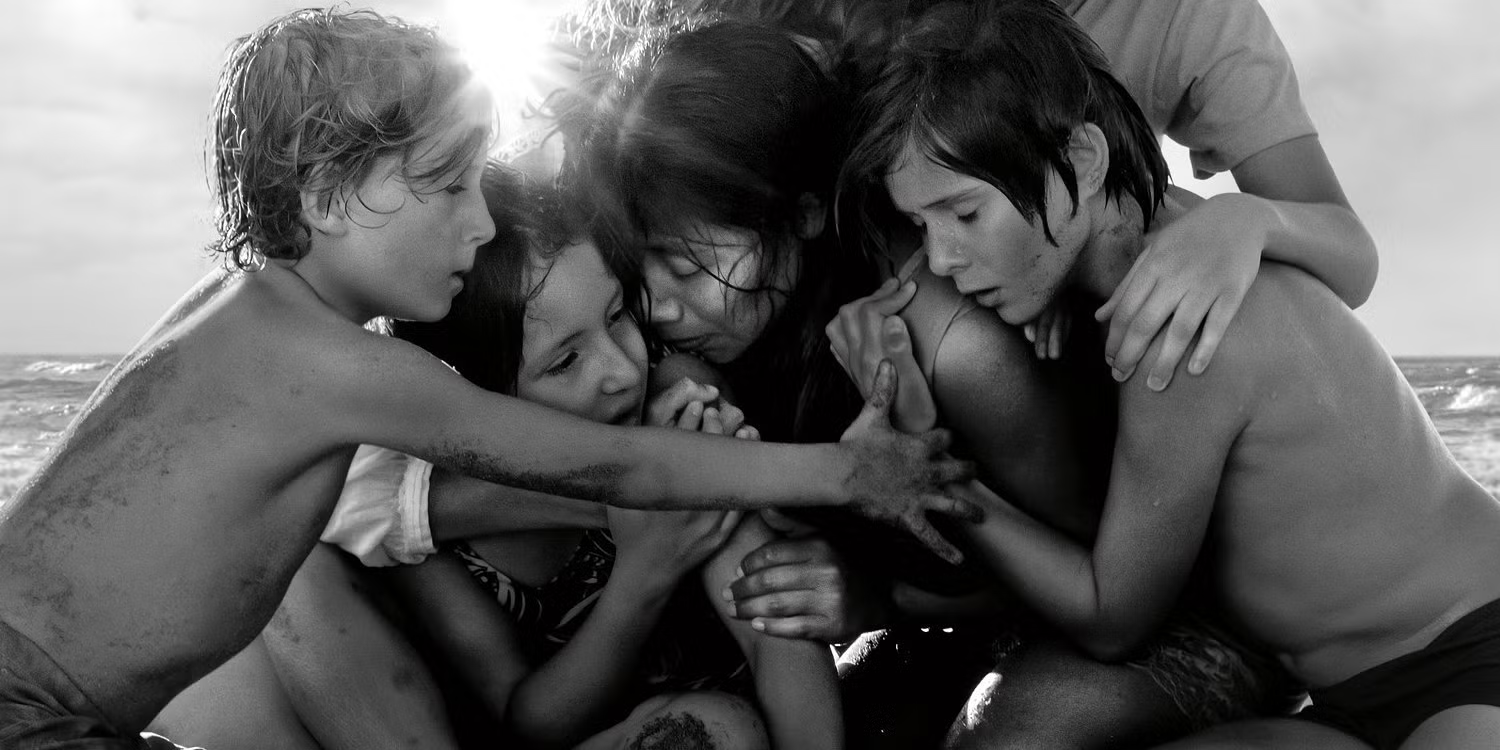
This is the film. Shot in luminous black and white, Roma follows Cleo — an Indigenous Mixtec woman working as a live-in housekeeper and nanny for a middle-class family in 1970s Mexico City. Cuarón drew from his own childhood and from his memories of the real woman who raised him. Accepting his Best Director Oscar, he dedicated the award to “one of the 70 million domestic workers in the world without work rights.”
Cleo is not a supporting character in someone else’s story. She is the gravitational center — her interior life, her grief, her desire, her quiet and unshakeable dignity rendered with a completeness that most caregiving characters in film never receive. If you watch one film from this list, make it this one.
The Second Mother / Que Horas Ela Volta? (2015)
Directed by Anna Muylaert — Brazil — Sundance Special Jury Prize, Berlin Panorama Audience Award
Val (Regina Casé) has spent thirteen years as a live-in nanny for a wealthy São Paulo family, pouring her care into their son while her own daughter has grown up elsewhere. When the daughter arrives to take university entrance exams, the invisible architecture of the household — who sits at which table, who swims in which pool, who is and isn’t a guest — begins to crack. Warm, funny, and quietly devastating. Director Muylaert has said she made the film because she wanted to honor “those who give affection but will never be part of the family.”
The Maid / La Nana (2009)
Directed by Sebastián Silva — Chile — Sundance World Cinema Jury Prize
Raquel (Catalina Saavedra) has worked for the same Chilean family for over twenty years. She knows every corner of the house, every rhythm of the household, and has built her entire identity around it. When the family hires additional help, Raquel’s world begins to tilt. A black comedy about loyalty, identity, and the strange intimacy of domestic service — what it means when a person’s entire sense of self is constructed inside someone else’s home, and what happens when that arrangement is threatened. Watch this one as a double feature with The Second Mother. They approach the same profession from completely different emotional registers, and together they tell more of the truth than either does alone.
The Films of Lucrecia Martel — La Ciénaga (2001), The Headless Woman (2008)
Argentina — MUBI — Multiple Cannes nominations, consistently ranked among the greatest films of the 21st century
Argentine director Lucrecia Martel is one of the most rigorous filmmakers working today on questions of class, race, and domestic labor. Her films are immersed in households where Indigenous and mestizo workers move through the edges of the frame — present, essential, treated as near-invisible by the wealthy Argentine families at the center. In The Headless Woman, a woman hits something with her car and cannot determine whether it was a person or a dog. The workers are so thoroughly outside her perception that their lives and deaths register only as obstacles. Martel’s work is the most formally sophisticated treatment of this subject in world cinema.
ASIA AND SOUTHEAST ASIA
Ilo Ilo (2013)
Directed by Anthony Chen — Singapore — Cannes Camera d’Or: Best First Film
Set during the 1997 Asian financial crisis, Ilo Ilo follows Terry (Angeli Bayani), a Filipina domestic worker who comes to Singapore to care for a middle-class family’s young son. Director Anthony Chen drew from his own childhood — from memories of the Filipina woman who worked in his home. After the film won at Cannes, he traveled to the Philippines to find her. They had lost contact for sixteen years. She had kept photographs of his family the whole time.
That story is the emotional truth the film is built around: what does it mean to love a child you have no legal claim to, in a country that offers you no protection? Special screenings were held for domestic workers in Singapore and Hong Kong. They laughed at things Singaporean audiences never noticed — nuances invisible to everyone except the people living them.
A Tale of Three Sisters / Kız Kardeşler (2019)
Directed by Emin Alper — Turkey — Berlin International Film Festival FIPRESCI Prize — MUBI
Three sisters from a poor rural Turkish village are sent out to work as domestic helpers for wealthier families in different towns. A quiet, precise film about what rural women are expected to sacrifice in service to other families, and what that cost looks like from inside a family that has been sending its daughters away for generations. Not a caregiving film in the traditional sense — but an important one for understanding the global economics of who does this work and why.
Parasite (2019)
Directed by Bong Joon-ho — South Korea — Academy Awards: Best Picture, Best Director, Best Original Screenplay, Best International Film
Not a caregiving film in the traditional sense, but the most globally watched examination of class and domestic labor in recent cinema. The Park family’s housekeeper and the Kim family’s infiltration of the household reveal the invisible architecture that structures every caregiving relationship: the profound asymmetry between those who employ and those who serve, the way warmth and exploitation can occupy the same space. Bong Joon-ho has said he wanted to make a film about “a staircase” — the ones you climb and the ones you descend. This is that film.
MIDDLE EAST AND AFRICA
Capernaum (2018)
Directed by Nadine Labaki — Lebanon — Cannes Jury Prize, Academy Award Nominee
Among its interwoven storylines, Capernaum follows Rahil, an undocumented Ethiopian domestic worker in Beirut caring for her infant son while hiding her immigration status from her employer. The film makes visible the kafala sponsorship system used across much of the Middle East, which ties a worker’s legal status entirely to their employer — workers cannot leave, cannot seek other employment, and can be deported if the sponsor withdraws. Capernaum asks who is actually caring for the world’s most vulnerable children — and who is caring for the people doing that work.
Atlantics / Atlantique (2019)
Directed by Mati Diop — Senegal/France — Netflix and Criterion Channel — Cannes Grand Prix; first Black female director to win a major prize at Cannes
Not a caregiving film in the traditional sense, but a film that belongs in this conversation for what it captures about the women left behind when labor migration pulls the people they love toward wealthier countries. Set in Dakar, Atlantics follows Ada, a young woman whose fiancé disappears at sea after leaving Senegal to seek work abroad.
Mati Diop’s film circles the same geography as Nanny from the opposite direction — the women who stay and wait, and what that waiting costs. Together they create a portrait of the global care economy from both sides of the ocean, the sending end and the receiving end. Watch them in sequence.
Difret (2014)
Directed by Zeresenay Berhane Mehari — Ethiopia — Sundance Audience Award: World Cinema Dramatic
Set in rural Ethiopia, Difret follows Meaza Ashenafi, a lawyer defending a fourteen-year-old girl who killed her abductor in self-defense after being taken for a forced marriage. The film is rooted in the same legal and cultural structures that have long governed what women in Ethiopia — including domestic workers and caregivers — are and are not permitted to claim for themselves. Difret is named for an Amharic word that means both “brave” and “to rape” — a duality the film examines with precision and without sentiment.
Where to Look Next: The Narrative Belongs to Everyone Who Lives It
We’ve talked about the nannies who became cultural touchstones — Mary Poppins, Nanny McPhee, Mrs. Doubtfire. We talked about the way these characters expanded what people imagined a nanny could be.
We believe that.
And we also believe this: the profession those characters represent is made up of approximately 2.5 million workers in the United States alone, according to the National Domestic Workers Alliance. The majority are women of color. A significant portion are immigrants. Many have children of their own at home. Many have spent decades in this field, building expertise in child development, behavior, and education that doesn’t come with a formal credential but is no less real for that.
That is who nannies actually are. Not a monolith — but a workforce that is predominantly non-white, deeply experienced, globally connected, and almost entirely absent from the cultural images that get recycled every time someone writes about this profession. The gap between the real workforce and the pop culture archive isn’t a small discrepancy. It’s a near-total inversion.

We know this from our own work. Over more than a decade of matching nannies with families across the country, we’ve worked with caregivers from dozens of countries, with training and life experience that rarely fits the images most families arrive with. We’ve watched families be surprised by candidates who didn’t match what they’d pictured — and then watch that surprise dissolve the moment they started actually working together. Representation matters here in a specific and practical way. The stories we tell about a profession shape who families imagine when they picture a nanny, who gets considered for positions, who gets taken seriously, and whose expertise gets treated as legitimate.
Changing the narrative isn’t a gesture. It’s a direct intervention in who gets seen, who gets hired, and whose labor gets valued.
Intentionally sharing more accurate representations — the films above, the books, the real history — is part of how the default image changes. Not by erasing the nannies pop culture remembers, but by making room for the full picture: the Senegalese immigrant in Manhattan, the Indigenous Mixtec woman in Mexico City, the Filipina caregiver in Singapore, the Brazilian nanny whose daughter grew up without her, the Chilean woman who built her entire world inside someone else’s home. These are not edge cases or special categories. They are the center of this profession’s actual story.
.avif)
The next time someone in your world — a parent, a family, a prospective nanny, a colleague — reaches for the same small set of references, hand them something better. The films are there. The books are there. The history is there. The conversation about why it stays buried is there too. It just requires someone deciding to surface it.
Lastly - we want to thank the nannies who reached out to us to share their favorite depictions of nannies in film, or share their stories and perspectives on how all agencies and organizations in our industry can support and celebrate representation in every form. We are so grateful for the incredible community of nannies we have gotten to work with and form relationships with over the past thirteen years, and don’t take your trust and desire to add to the conversation for granted. If you’d like to add to the list above, please email us at marketing@adventurenannies.com so that we can keep the list growing!