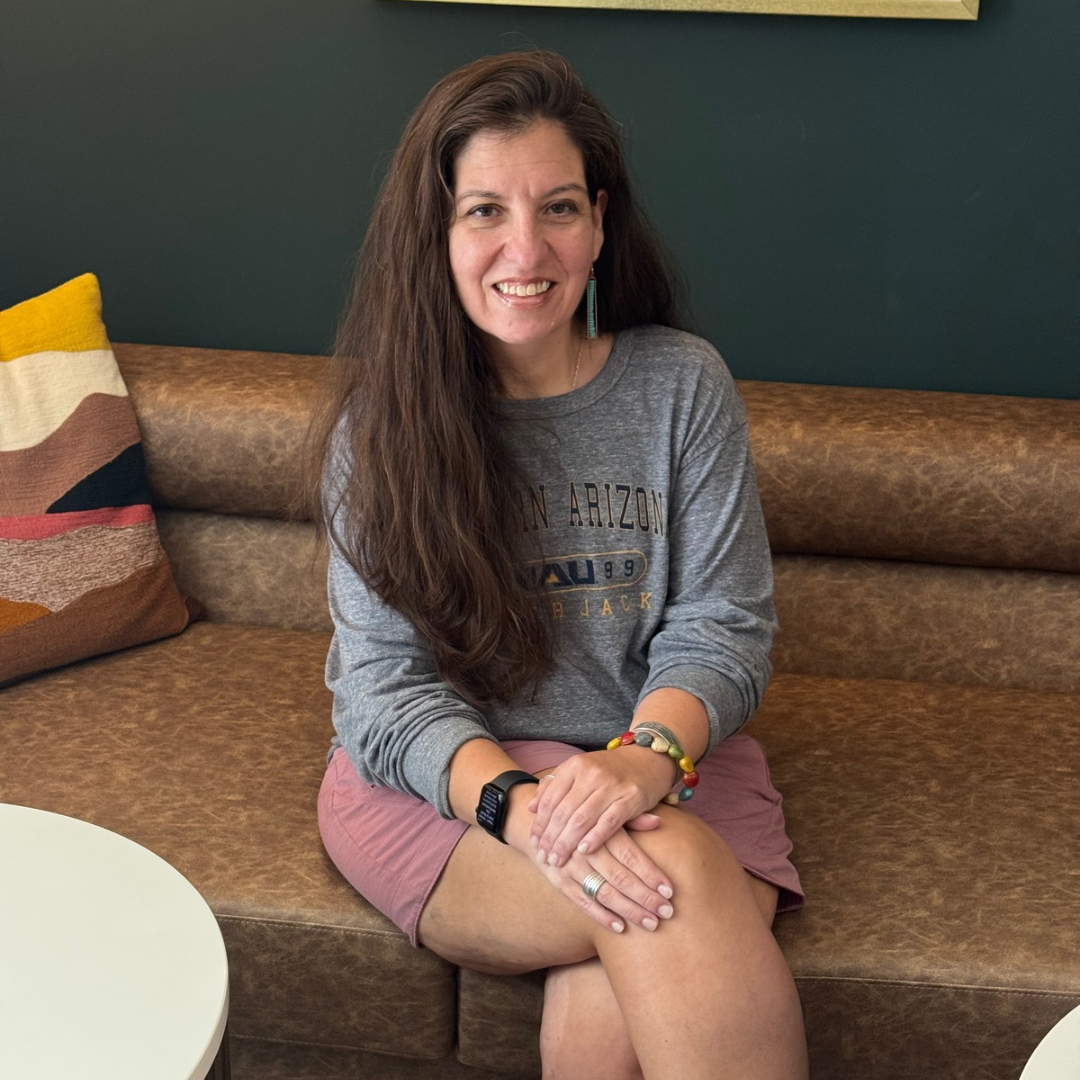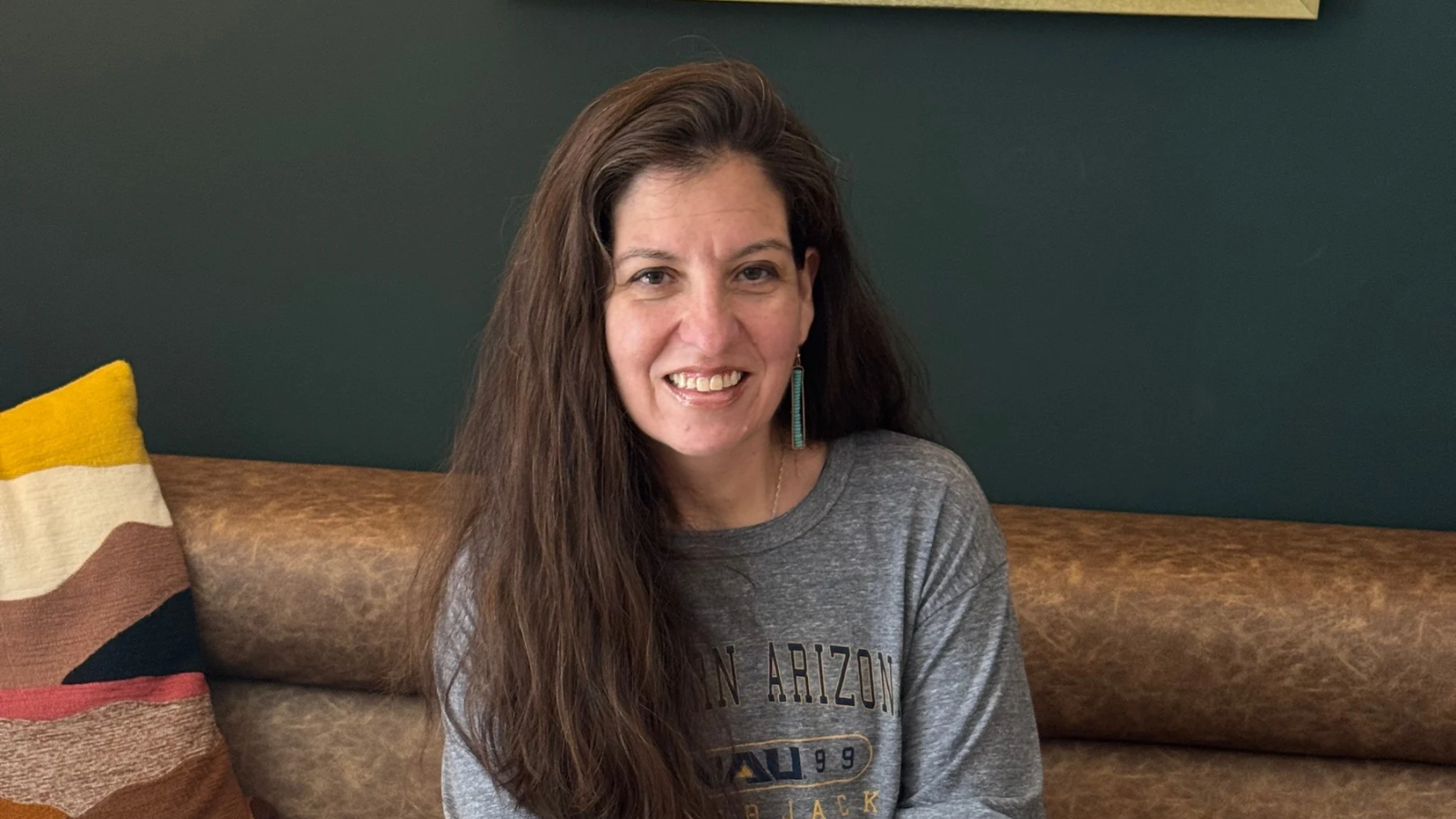
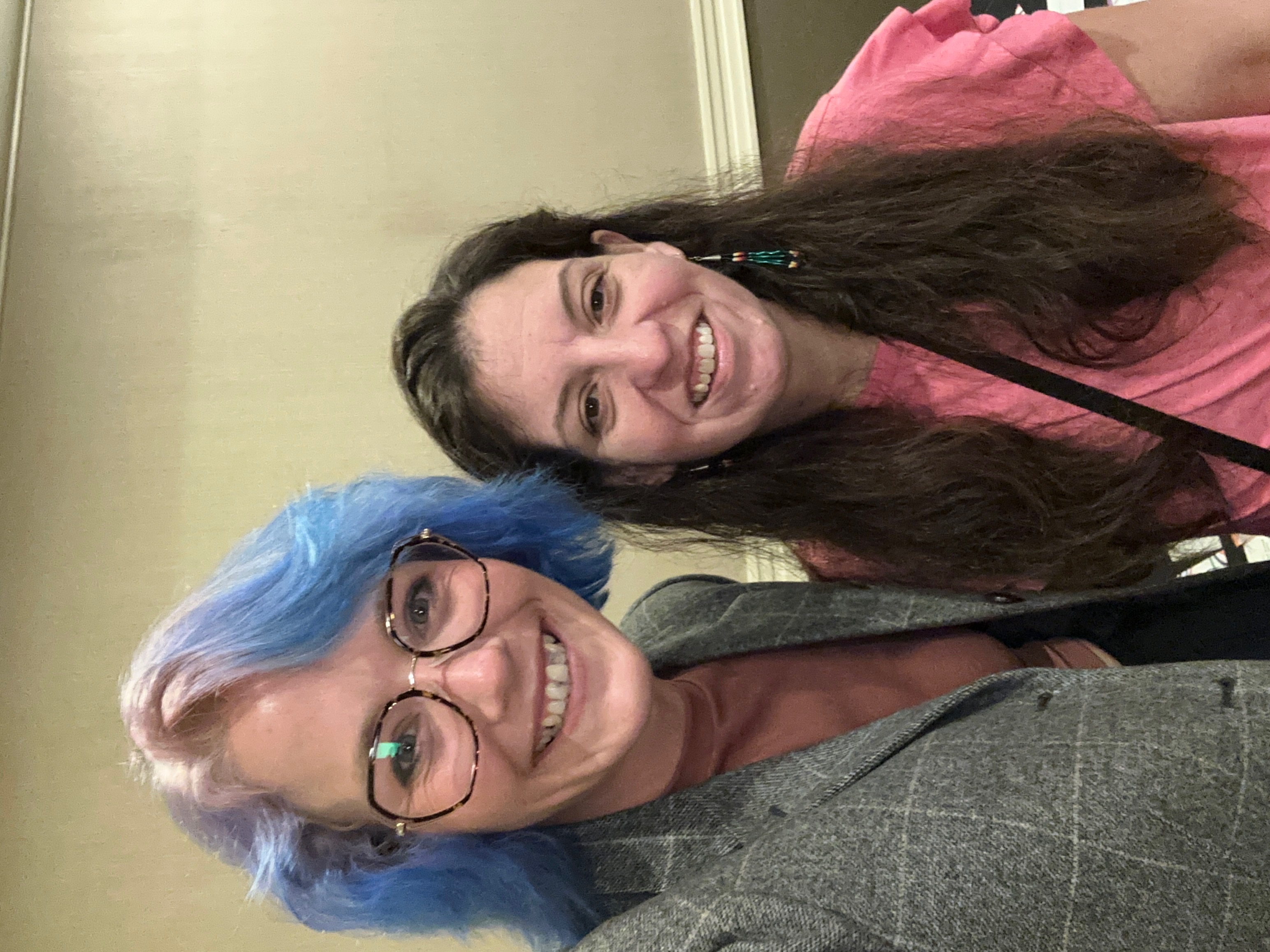
A note from the Adventure Nannies team: Every November, nannies, parents, and educators in our community plan the crafts, pick the picture books, and field kids’ questions about Thanksgiving. This year we asked Emily Vass, MS, MA, to share what this season has meant to her as a citizen of the Lenni Lenape of Oklahoma (Delaware Tribe of Indians) and the Chahta (Choctaw Nation of Oklahoma). We met Emily at Nannypalooza 2024 and were taken with her right away, and we’re lucky to have her serving on our Community Advisory Council. We haven’t changed her words or her message. What follows is Emily’s story, told her way, and it speaks for her, not for all Native people. We’re so grateful she shared it with us.
My earliest memories are of being praised for my skin, my hair, and my quiet. Strangers stroked my long brown hair like I was a pet, remarking on how gorgeous and thick it was. I was well trained in politeness, in the belief that children should be seen and not heard. Growing up in rural Ohio, my dad was a celebrity every fall, and I became his little accessory at each elementary school I attended.
In third grade he helped me write my Young Authors project on the Lenni Lenape people, and that's when I first met the "thems" and "us" of my story. It was the start of a lifetime of code-switching as a mixed-blood kid, and of an emotional tornado that returned every November, as I realized I was part of a story others would mistell and project onto me.
I'm Emily, an enrolled member of the Lenni Lenape of Oklahoma (Delaware Tribe of Indians) and the Chahta (Choctaw Nation of Oklahoma), and a third-generation survivor of the boarding schools. I'm writing as myself, not for all Native people. There are 574 federally recognized tribes in the United States, and our relationships with this "holiday" are as varied as we are, shaped by each family's experience of forced assimilation.
As a child, late November looked like any American family gathering, with an undercurrent. My parents were pulled between two families, and neither felt fully safe with their in-laws. My mother's family farmed, one of the few English farms in an Amish community: louder, bigger, cousins everywhere. My dad's family lived in town, with nice plates and richer food, and just my brother, me, and my grandmother's dog, Misty Moo for entertainment. Then one year an aunt on my mother's side called me biracial, my parents fought about it, and I hid under the adults' table. All at once I understood the stress I'd felt every fall, and why this day never felt like a holiday. I had become openly aware of the racial tension between my two families.
The story I was taught vs. the story I know
At school, the story was simple: Pilgrims arrived hungry, Native people helped them, everyone shared a meal, and then we vanished from the narrative. By fifth grade I was angry, because every year I knew the wrong story was being told to my friends. Each Thanksgiving my dad came in as guest speaker, doing his best to offer a more accurate picture of who we were as "Indians." That was an uphill climb in Ohio, where Chief Wahoo, the old mascot of the Cleveland Indians, grinned from thermoses and sweatshirts with his toothy smile and red skin. For most kids, he was the only picture of an Indian they had. My dad chose to be the soft, kind presence, knowing many in those small communities held harsh thoughts about him, and he took pride in every invitation as a chance to push against stereotypes.
At home, I learned my two families were at odds, managing their feelings about the two mixed children who tied them together. I was well into adulthood before I realized my parents married only about ten years after Loving v. Virginia. That helped me make sense of what my mom's family called biracial and my dad's family called mixed blood. The two versions never matched, and I was the one standing in the gap.
The fuller history is rarely told. In 1621, the Wampanoag, whose homelands had been theirs for thousands of years, shared a harvest gathering with the colonists at Plymouth, shaped by a fragile alliance. But the "first Thanksgiving" is largely a later invention. Lincoln made it a national holiday in 1863 after years of campaigning by Sarah Josepha Hale. Less than a year earlier, he had approved the hanging of 38 Dakota men in Mankato, Minnesota, the largest mass execution in U.S. history. Colonial leaders had also declared thanksgivings to celebrate violence against Native nations, including the 1637 attack on the Pequot village at Mystic. The cheerful greeting-card picture was assembled generations later, and the people and communities it erased were still alive. We are still here, we are not mascots, we are not costumes.
What Thanksgiving looks like in my life
Today, my husband, our children, and I use the day for remembrance and mourning. We often travel to a powwow to honor our ancestors and be somewhere that feels safer than participating in untruths we recognize. The day after, we cook and rest. Gratitude was never the thing missing. As Native people, we live it in small moments every day, in reciprocity with the land and our relationships.
The day also holds a conflict. My family has abundance, and we have relatives who have lived under boil-water notices for years. My grandfather beat the statistics and raised his family up from hardship, yet at the end of her life his widow, my grandmother, still had no potable water. She is considered fortunate because she didn't have to rely on the tribe's food pantry or water donations. That's what this day shows me: how many in our community still fight for basics, and how casually society treats our existence, like we're mythical unicorns, acknowledged only for the part of the story that flatters the colonizers' descendants.
When I was in college, the matriarch of our family suggested we move our gathering to mid or late October. It was our resistance and our protest. We travel home and spend sacred time together, away from the hurtful and often racist encounters of "Thanksgiving." It's how we raise the next generation to understand that it isn't our burden to teach others what they don't know, but it is our responsibility to name misinformation and the harm it does.
What I want people to know
If you're reading this from outside my community, here's what I'd ask you to take with you.
We're still here. Native/Indigenous people aren't a chapter in a textbook. We're nurses, teachers, engineers, writers, and your neighbors. I'm a social scientist, deathworker, and liberation therapist, and I broke many statistics to be in a position to be asked to write this.
Gratitude and honesty can coexist. Being thankful doesn't require believing a myth. The question isn't "Should I enjoy Thanksgiving?" It's "Can I enjoy it without lying about where it came from?"
Small things help. Learn whose land you live on (native-land.ca is a good start), read Native authors, support Native-owned businesses, and check whether your local school is teaching the pageant or the history.
Closing
I've rewritten this season for my own children. They had laughter, big emotions, and a mother who named generational wounds and healing gifts. They know how oppression and erasure shaped their grandparents and great-grandparents, and now, as young adults, they see how differently the rest of the nation celebrates, largely through an uninformed, capitalistic lens.
Gratitude was never the problem. My communities on both sides have given thanks for the harvest, the rain, and each other for longer than this country has existed. The problem was the story that made us a footnote in someone else's thanksgiving.
To the caregivers, nannies, parents, and educators reading: how can you hold gratitude for your life while using your privilege to reduce the harm of this misinformation? Talk with Native leaders near you, and listen to the community members who can teach you.
Emily Vass, MS, MA is an enrolled citizen of the Lenni Lenape of Oklahoma (Delaware Tribe of Indians) and the Chahta (Choctaw Nation of Oklahoma). A social scientist, death worker, and liberation therapist, she writes and speaks about Indigenous identity, generational healing, and honest mental health experiences.
Invite Emily to speak or facilitate. Emily offers talks and guided round table discussions for schools, caregivers, healthcare and community organizations, and workplaces on teaching honest history, supporting Native children and families, and holding gratitude and truth together. To request her for an event, email emily@reinforcingwishes.com with your audience, format, and date, and she'll reply with availability and options.